


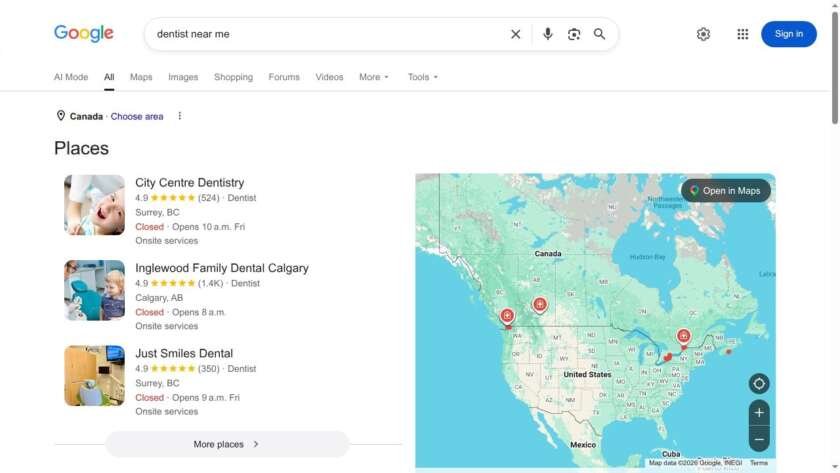
If your dental practice isn’t showing up when someone searches “dentist near me” in your city, you’re not just missing a click. You’re handing that patient to the practice down the street, possibly for the next 10 to 20 years.
That’s not an exaggeration. According to CuFinder’s 2026 data, the average dental patient has a lifetime value of $3,000 to $40,000 depending on treatment mix. A single new patient acquired through digital marketing can return 20 to 40 times the cost of acquiring them.
The reality: 71% of prospective patients run a web search before booking an appointment. If your practice isn’t visible at that moment, no amount of word-of-mouth will fully compensate.
The good news is that most dental practices in Canada are still getting digital marketing wrong, which means the bar to outperform them isn’t as high as you’d think. This guide covers exactly what works in 2026: local SEO, Google Ads, online reviews, and how AI search is reshaping patient discovery. No fluff, just the strategies that actually fill appointment books.
Here’s what we’ll cover:
- How to dominate local search and the Google Maps pack
- When to run Google Ads (and when not to)
- Why your review strategy is probably your biggest missed opportunity
- How AI search engines are changing the game for dental practices
- How to put it all together into a budget that makes sense
Local SEO: The Foundation Every Dental Practice Needs
Local SEO is not optional for dental practices. It’s the single highest-ROI digital channel you have access to, and the data backs that up clearly.
According to BrightLocal’s 2026 research, Google Business Profile signals account for 32% of Local Pack ranking weight. That’s the three-pack of map results that appears at the top of Google when someone searches “dentist [your city].” No other single ranking factor comes close.
What this means practically: before you spend a dollar on ads, your Google Business Profile needs to be fully optimized.
Optimize Your Google Business Profile First
The top 10% of dental practices generate 3 times more profile actions (calls, website visits, direction requests) than the average practice. The difference isn’t luck. It’s execution.
Here’s what a fully optimized GBP looks like:
- Complete every field: Name, address, phone, hours, services, website, and photos. Practices with 95% or higher profile completion dominate the Maps pack.
- Choose the right categories: “Dentist” as your primary, with secondary categories like “Cosmetic Dentist” or “Dental Clinic” where applicable.
- Add service-specific pages: Break out cleanings, whitening, implants, and orthodontics as separate services with descriptions.
- Post weekly: Google rewards active profiles. Even short updates about office hours, new services, or patient tips signal an active, credible business.
- Upload photos consistently: Practices with 100+ photos receive significantly more direction requests and website clicks.
NAP Consistency Across Directories
Your Name, Address, and Phone number (NAP) need to be identical across every online directory: Google, Yelp, Yellow Pages, Healthgrades, RateMDs, and any local Canadian directories relevant to your province.
Flento’s 2026 research found that practices with consistent NAP across 25 or more directories rank 2.4 positions higher in the Local Pack. That’s the difference between appearing in the top three results or not appearing at all.
On-Page SEO for Your Website
Your website needs location-specific pages targeting the neighbourhoods and cities you serve. A practice in Mississauga, for example, should have pages targeting “dentist Mississauga,” “dentist Port Credit,” and “dentist Streetsville” separately. Each page needs:
- A unique H1 with the location keyword
- Embedded Google Map
- Local schema markup (LocalBusiness + Dentist)
- A clear call-to-action to book an appointment
Organic search drives 48.2% of all dental website traffic globally. Getting this right compounds over time in a way paid ads simply can’t replicate.
Google Ads for Dentists: Fast Results, If You Do It Right
Local SEO is the long game. Google Ads is how you fill your schedule while SEO builds momentum. The two channels work best together, not as alternatives.
Here’s the honest picture on dental Google Ads in 2026:
| Metric | Dental Benchmark | Source |
| Average CPC | $7.85 | WordStream |
| Average cost per lead | $83.93 | WordStream |
| Conversion rate (well-managed) | 4% to 10%+ | RYN Digital |
| Cost per booked patient (general) | $150 to $200 | CuFinder |
| Cost per booked patient (implants) | $350 to $500 | CuFinder |
| Average patient lifetime value | $4,000 to $8,400 | CuFinder |
The math works. A patient acquired for $200 on a general dentistry campaign is worth $4,000 to $8,400 over their lifetime. That’s a 20 to 40 times return on a well-managed account.
What to Advertise (and What to Skip)
Not every dental service justifies the cost-per-click in a competitive Canadian market. Focus your ad spend where the lifetime value is highest:
- High-value targets: Dental implants, Invisalign, teeth whitening, full-mouth restorations, and emergency dental. These patients have high intent and high LTV.
- Bread-and-butter campaigns: “Dentist near me” and “[city] dentist” campaigns for new patient acquisition. Lower LTV per patient but higher volume.
- Skip for now: Routine cleaning promotions via search ads. The CPC rarely justifies the revenue on a single cleaning appointment.
Campaign Structure That Actually Converts
The biggest mistake dental practices make with Google Ads isn’t the budget. It’s sending all traffic to the homepage. A dedicated landing page for each service converts at 12.5% versus 4.2% for a general website page, according to CuFinder’s 2026 benchmarks.
Your landing pages need:
- A headline that matches the search query exactly (e.g., “Dental Implants in [City]”)
- A single, clear call-to-action (book an appointment or call now)
- Social proof: star rating, number of reviews, and a patient quote
- Fast load time on mobile (over 60% of dental traffic is mobile)
- No navigation menu to distract from the conversion goal
One more thing: 71% of dental advertisers now run Performance Max campaigns, but they require careful asset management and conversion tracking to perform well. If you’re not monitoring which asset groups are converting, you’re likely burning budget on irrelevant placements.
Online Reviews: Your Most Underused Growth Channel
Most dental practices treat reviews as something that just happens. The best-performing practices treat reviews as an active acquisition strategy.
The numbers are stark: 77% of new dental patients check online reviews before choosing a provider, and 52% will only consider a practice with 10 or more ratings. If you have fewer than 10 Google reviews right now, a significant portion of your potential patients are quietly ruling you out before they ever visit your website.
The trust multiplier is real: the top 10% of dental practices generate 2.7 times more trust signals than the average practice. That gap doesn’t happen by accident.
How to Build a Consistent Review Pipeline
The mistake most practices make is asking for reviews inconsistently: a receptionist remembers to ask sometimes, a follow-up email goes out occasionally. That approach produces a trickle. Here’s a system that produces a stream:
- Ask at the right moment: The best time is immediately after a positive interaction, typically right after treatment when the patient is relieved and happy. Train every staff member to recognize that moment.
- Make it frictionless: Send a text message within an hour of the appointment with a direct link to your Google review page. The fewer clicks between the patient and the review, the higher your completion rate.
- Use your email list: A simple monthly email to your existing patient base asking for a review, if they’ve had a good experience, consistently outperforms cold review requests.
- Respond to every review: Google rewards businesses that engage with their reviews. Responding to negative reviews professionally, without being defensive, is one of the most powerful trust signals you can send to prospective patients reading those reviews.
Reviews and Local Pack Rankings
Here’s the connection that most practices miss: reviews don’t just influence patient decisions. They directly affect your Local Pack ranking. Google Business Profile signals, which include review quantity, recency, and response rate, account for 32% of your Maps ranking. A practice with 200 recent reviews and a 4.8-star rating will consistently outrank a practice with 30 old reviews and a 4.2-star rating, even if the lower-rated practice has a better website.
Map pack visibility improvements can appear within 8 to 12 weeks for practices with an optimized GBP and a structured review generation process. That’s a relatively fast win compared to most SEO timelines.
AI Search and What It Means for Your Practice in 2026
Something shifted in how patients find healthcare providers in 2025, and it’s accelerating in 2026. AI-powered search tools like Google’s AI Overviews, ChatGPT, and Perplexity are increasingly the first stop for health-related queries. “What’s the best dentist in [city]?” is now as likely to be asked in a chat interface as it is in a traditional Google search.
This isn’t a reason to panic. It’s a reason to adapt early, because most dental practices haven’t.
How AI Engines Decide Which Practices to Recommend
AI search engines pull from structured, credible, well-organized web content. For dental practices, the practices most likely to appear in AI-generated recommendations share a few characteristics:
- Detailed, well-structured service pages: AI engines extract information from individual service pages. A page that clearly explains what dental implants are, who they’re for, what the process involves, and what they cost is far more likely to be cited than a generic “Services” page with bullet points.
- Consistent local signals: The same NAP consistency that helps your Google Maps ranking also helps AI engines verify your practice as a legitimate local business.
- Strong review presence: AI systems use review data as a trust signal. Practices with high ratings across multiple platforms (Google, RateMDs, Healthgrades) appear more authoritative to AI engines.
- FAQ content: Patients ask AI tools questions like “how long do dental implants last?” and “does Invisalign hurt?” Practices that have FAQ sections answering these questions on their websites are more likely to be cited in those responses.
Voice Search Is Already Here
58% of users leverage voice search to find local businesses, and dental is one of the highest-intent local search categories. Voice queries are conversational: “Who is the best dentist near me that takes new patients?” Your content needs to answer these questions directly and naturally.
The practices that invest in structured content now, clear service pages, FAQ sections, and location-specific information, will have a significant advantage as AI search continues to take share from traditional Google results.
The bottom line: AI search optimization for dental practices isn’t a separate strategy. It’s the result of doing local SEO, content, and reviews well. The same work compounds across both traditional and AI-powered search.
Putting It Together: A Realistic Budget Framework for Canadian Dental Practices
The question every practice owner eventually asks is: “How much should I actually be spending?”
The research is consistent: practices that allocate 4% to 12% of revenue to marketing see measurably higher year-over-year growth than those spending less. For a practice generating $800,000 annually, that’s $32,000 to $96,000 per year, or roughly $2,700 to $8,000 per month.
Here’s how to think about allocating that budget across channels:
| Channel | Monthly Investment | Time to Results | Best For |
| Local SEO + GBP | $1,500 to $3,000 | 3 to 6 months | Long-term patient flow |
| Google Ads | $2,000 to $5,000+ | Immediate | High-value services, new patient volume |
| Review Management | $300 to $500 | 8 to 12 weeks | Trust, Local Pack ranking |
| Website / Landing Pages | One-time or ongoing | Immediate impact | Conversion rate improvement |
| Social Media (Meta) | $500 to $1,500 | 1 to 3 months | Cosmetic procedures, brand awareness |
A note on sequencing: If you’re starting from scratch, prioritize in this order: GBP optimization and reviews first (fastest ROI, lowest cost), then Google Ads for immediate patient flow, then SEO for long-term compounding growth.
What Separates High-Growth Practices
The practices that consistently outperform their local competitors aren’t spending more. They’re being more strategic about where the money goes and how the channels work together. A well-optimized GBP reduces your cost per lead from Google Ads. Strong reviews improve your organic ranking. Better landing pages make your ad spend go further.
None of these channels is a silver bullet on its own. The compounding effect of doing all of them well is where the real growth happens.
If you’re unsure where your practice stands right now, the most valuable first step is an honest audit: where are you visible, where are you invisible, and what’s it costing you in missed appointments every month?
Ready to Grow Your Practice?
Digital marketing for dental practices isn’t complicated, but it does require consistency, the right channel mix, and someone who knows what they’re doing managing it.
At PSM Digital Agency Canada, we work with dental practices across Canada to build patient acquisition systems that actually perform. From local SEO and Google Ads to review strategy and AI search optimization, we handle the full picture so you can focus on running your practice.
Book a free strategy call with our team and we’ll walk through your current visibility, identify your biggest growth opportunities, and put together a plan that fits your market and your goals. No pressure, just a clear picture of where you stand and what it would take to grow.
What is the best digital marketing channel for dental practices in Canada?
Local SEO is usually the best place to start because it helps your practice show up in Google Maps and local search results when patients are actively looking for care. Once that foundation is in place, Google Ads can add immediate lead flow while reviews and landing pages improve conversion rates.
Should dental practices run Google Ads or focus on SEO first?
SEO should come first if your Google Business Profile, website, and local signals are weak. Ads can drive faster results, but they work best when paired with a strong local presence and dedicated landing pages. If you skip the foundation, you usually pay more for each lead.
How important are Google reviews for a dental clinic?
Very important. Reviews influence both patient trust and local ranking performance. A steady flow of recent, authentic reviews can improve your visibility in the Maps pack and make more prospective patients feel confident choosing your practice over nearby competitors.
What does AI search mean for dental marketing in 2026?
AI search rewards clear, structured, locally relevant content. Dental practices with strong service pages, FAQ sections, consistent business information, and credible reviews are more likely to be surfaced in AI-generated answers and recommendations.
How much should a Canadian dental practice spend on marketing?
A practical benchmark is 4% to 12% of revenue, depending on growth goals and competition in your market. Practices that want faster growth usually need to invest in both short-term channels like Google Ads and long-term assets like SEO and review generation.